Math Assignments
- Instructors
- Term
- Spring 2020
- Department
- Coral Teachers
Upcoming Assignments

No upcoming assignments.
Past Assignments
Due:
U.S. Coins
Due Date: May 15, 2020
For this week, we are having the students identify coins and their value. The due date is Friday May 15, 2020. If completed on Seesaw you do not need to upload to ClassDojo. If you are unable to complete assignments on the Seesaw app, please send a photo and upload it to ClassDojo. This way it will be possible to give recommendations to students on their work and archive their completed assignments.
Objective:
1.4 (A) identify U.S. coins, including pennies, nickels, dimes, and quarters, by value and describe the relationships among them
1.4 (B) write a number with the cent symbol to describe the value of a coin
Vocabulary: penny, nickel, dime, quarter, value
- Video-
https://www.youtube.com/watch?v=aajLkveG750
- Warm-Up- U.S. Coins
- Assignment 1- Identify U.S. Coins
- Assignment 2- Name That Coin!
Due:
Telling Time- Hour and Half Hour
Due Date: May 8, 2020
For this week, we are having the students go over time and telling time to the hour and half hour on an analog clock and digital clock. The due date is Friday May 8, 2020. If completed on Seesaw you do not need to upload to ClassDojo. If you are unable to complete assignments on the Seesaw app, please send a photo and upload it to ClassDojo. This way it will be possible to give recommendations to students on their work and archive their completed assignments.
Objective:
(1.7E) The students will be telling time to the hour and half hour using analog and digital clocks.
Vocabulary:
analog clock, digital clock, hour hand, minute hand, hour, half hour
- Time Video
https://www.youtube.com/watch?v=MaVgBjVh4b8
- Warm-Up- Telling Time
- Assignment 1- Hour and Half Hour- Telling Time
- Assignment 2- Time To The Hour and Half Hour
Due:
Telling Time To The Hour
Due Date: May 1, 2020
For this week, we are having the students go over time and telling time to the hour on an analog clock.
Vocabulary:
analog clock, digital clock, hour hand, minute hand, hour, skip counting
Objective:
(1.7E) The students will be telling time to the hour and half hour using analog and digital clocks.
- Time Video
https://safeyoutube.net/w/DX02
- Warm-Up- Telling Time Whole Hours
- Assignment 1- What's The Time?
- Assignment 2- Time To The Hour
Due:
Assignment
Due: Friday, April 24, 2020
For this week, we are having the students reviewing place value up to hundreds. This is to ensure that our scholars have more practice and demonstrate mastery of the subject or a better understanding of the concept.
Objectives
(1.2.B) Students will use concrete and pictorial models to compose and decompose numbers up to 120 in more than one way.
Vocabulary: digits, value, place value, ones, tens, hundreds
- Place Value Video
https://www.youtube.com/watch?v=EVnrsoyfRFU
- Warm Up
- Assignment 1
- Assignment 2
- Quiz
Due:
Assignment
Due: Friday, April 17, 2020.
For this week, we are having the students focus on place value up to hundreds.
Objectives
(1.2.B) Students will use concrete and pictorial models to compose and decompose numbers up to 120 in more than one way.
Vocabulary: digits, value, place value, ones, tens, hundreds
- Place Value Video
https://www.youtube.com/watch?v=a4FXl4zb3E4&feature=youtu.be
- Warm up: Tens and Ones Practice
- Assignment 1: Place Value Check
- Assignment 2: Place Value Concepts
- Assignment 3: Place Value
- Extra Work: Expanded Form/Place Value
Due:
Assignment
Due Date: Friday, April 10, 2020.
Objectives
(1.6.B) Students will distinguish between attributes that define two-dimensional or three-dimensional figures and attributes that do not define shapes. (1.6.D) Students will identify two-dimensional shapes, including circles, triangles, rectangles, and squares, such as special rectangles, rhombuses, and hexagons.describe attributes using formal geometric language. (1.6.E) Students will identify three-dimensional solids, including spheres, cones, cylinders, rectangular prisms (including cubes), and triangular prisms, and describe their attributes using formal geometric language.
Vocabulary: sides, vertices, faces, three-dimensional shapes, edges, cube, cylinder, cone, sphere
- Video - Three-Dimensional Shapes
https://www.youtube.com/watch?v=2cg-Uc556-Q&feature=youtu.be
- Assignment 1: 2D and 3D Shapes
- Assignment 2: I Can Sort 3D Shapes
- Assignment 3: Faces, Edges, and Vertices
- Review
Brain Pop Jr.-Shapes
https://www.youtube.com/watch?v=9YOAnCVxZnMDue:
Assignment
Due: Friday, April 03, 2020
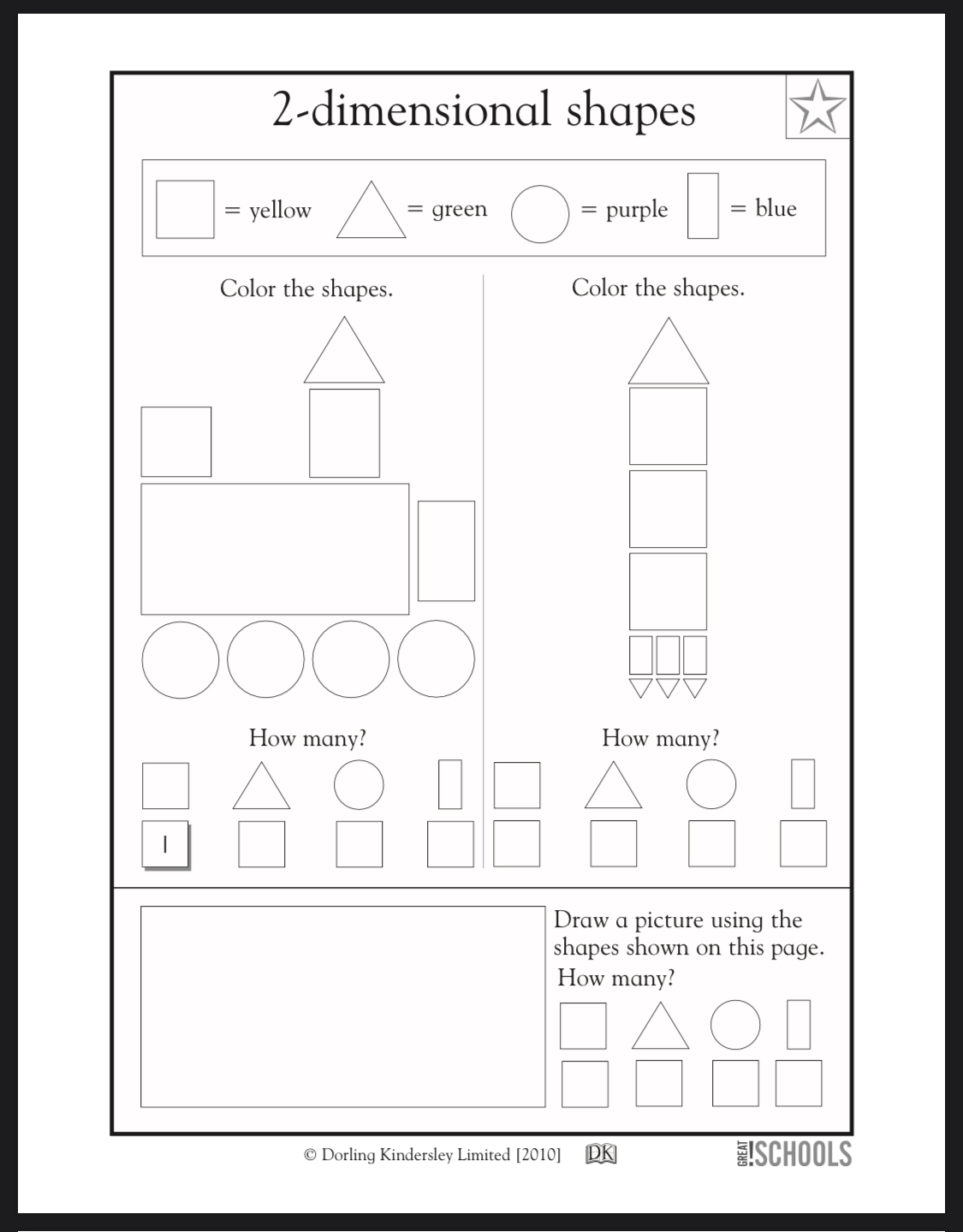
For, this week, we are having the students focus on two-dimensional figures.
Objectives (1.6.A) Classify and order regular and irregular two-dimensional shapes based on attributes using informal geometric language. (1.6.C) Create two-dimensional shapes, including circles, triangles, rectangles, and shields as special rectangles, rhombuses, and hexagons. (1.6.D) The students will identify two-dimensional shapes, including circles, triangles, rectangles, and squares, as special rectangles, rhombuses, and hexagons. Describe your attributes using formal geometric language. (1.6.F) Compose two-dimensional shapes by joining two, three, or four shapes to produce one more objective shape in a possible way.
Vocabulary: Sides, Vertices, Figures, Two-dimensional shapes
- Warm up
This warm-up is for the students to become familiar with what they are learning this week
- Vocabulary Power Point:
***** Assignments are attach as files to download if you do not have access to Seesaw Class.***
Due: